
Market Analysis
When Everyone Uses the Same AI Models, SatYield Creates Alpha from Data Others Don’t Have
AI models no longer create alpha. Exclusive data does.
AI has crossed a threshold many teams are still reluctant to acknowledge: model advantage is over.
Access to ChatGPT, Gemini, and other foundation models has created true model parity. The reasoning, summarization, coding, and analytical capabilities these systems provide are no longer differentiators. They are infrastructure.
As a result, analysts and research teams using the same models increasingly converge on the same structures, interpretations, and conclusions. Public data accelerates this effect. When everyone trains or queries models on the same filings, reports, APIs, and open datasets, outputs inevitably cluster. Prompting can refine presentation, but it cannot change the fact that the underlying information is shared.
When the tools are the same and the inputs are the same, the outputs converge. That reality removes the model itself as a durable source of advantage.
In today’s AI landscape, the only sustainable source of alpha is information asymmetry: insight built on data others do not have and cannot easily replicate. SatYield is engineered around that principle.
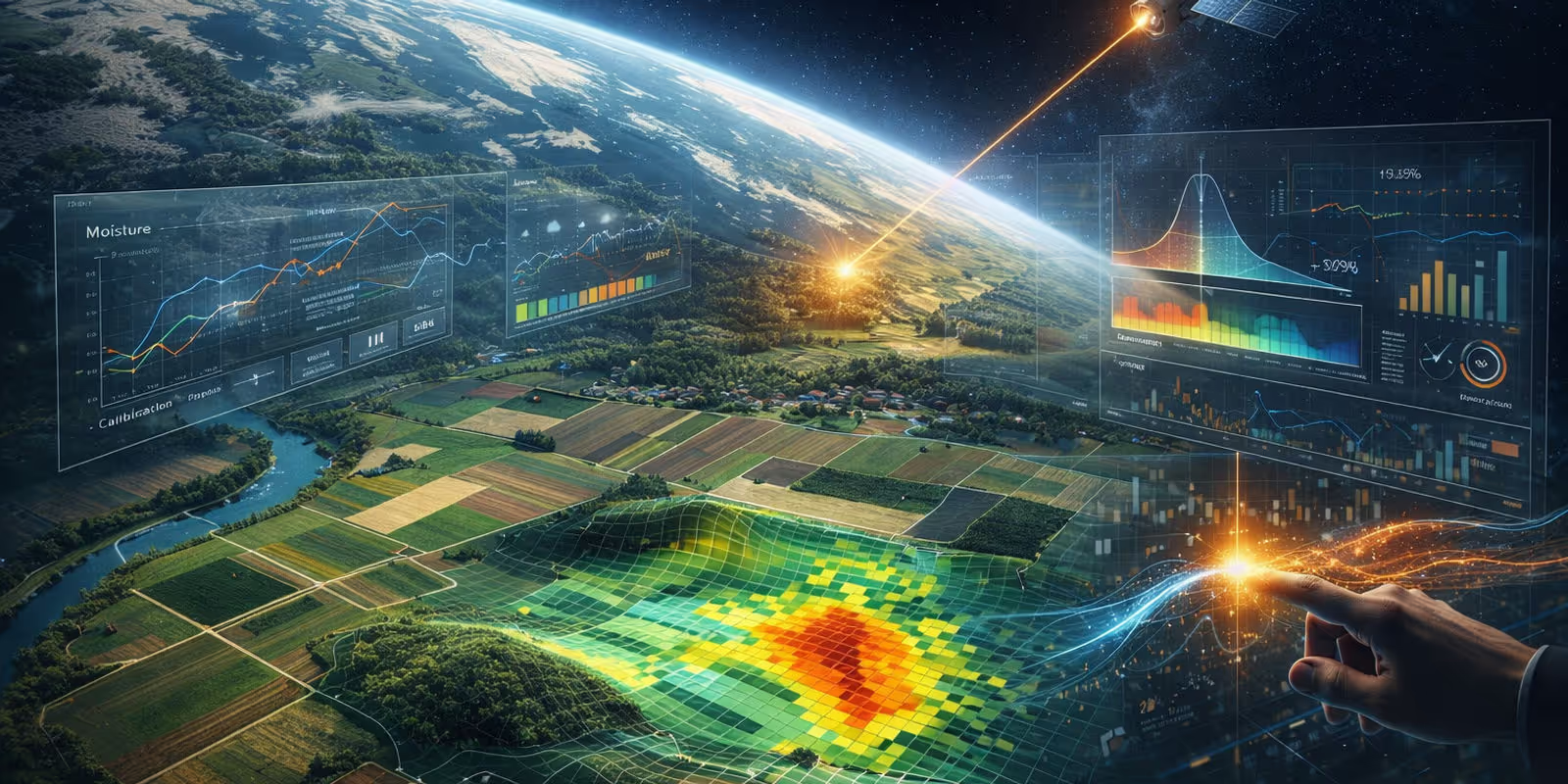
By combining satellite-derived intelligence, high-resolution environmental observation, and continuously learning digital twins capable of generating billions of synthetic datapoints each season, SatYield operates as a learning system that compounds faster than any workflow dependent on public or conventional data. When models are commoditized, differentiation comes from feeding them signals no one else sees.
Model Parity Is Real, and It Changes Where Advantage Lives
Strong foundation models collapse technical gaps. Two analysts using the same model will tend to converge in structure, reasoning, and output, Organizations building agents on the same underlying architectures will often produce workflows that look strikingly similar.
The implications are straightforward:
Automation alone does not create strategic advantage
Public datasets rarely produce differentiated predictions
Off-the-shelf agents tend to converge toward similar conclusions
This is why a model-centric strategy struggles to generate lasting alpha. An input-centric architecture can.
The Edge Comes from Data That Is Exclusive and Difficult to Recreate
As AI matures, value shifts away from model selection and toward data acquisition, data fidelity, and learning velocity, SatYield’s platform is built around an input layer designed to accelerate all three.
At its core, that layer integrates:
Multispectral and Synthetic Aperture Radar (SAR) satellite sources
Continuous in-season environmental observation
Physics-informed digital twins
Large-scale synthetic data generation tied to real-world calibration
Together, these components produce a dataset that is both broad and deep. It captures spatial variation, temporal dynamics, and environmental interactions at high resolution; the kind of information that cannot be recreated through web scraping or generic API access. Alpha emerges from this density of signal and continuity of observation.
Satellite Intelligence: Seeing Change Before It Becomes Obvious
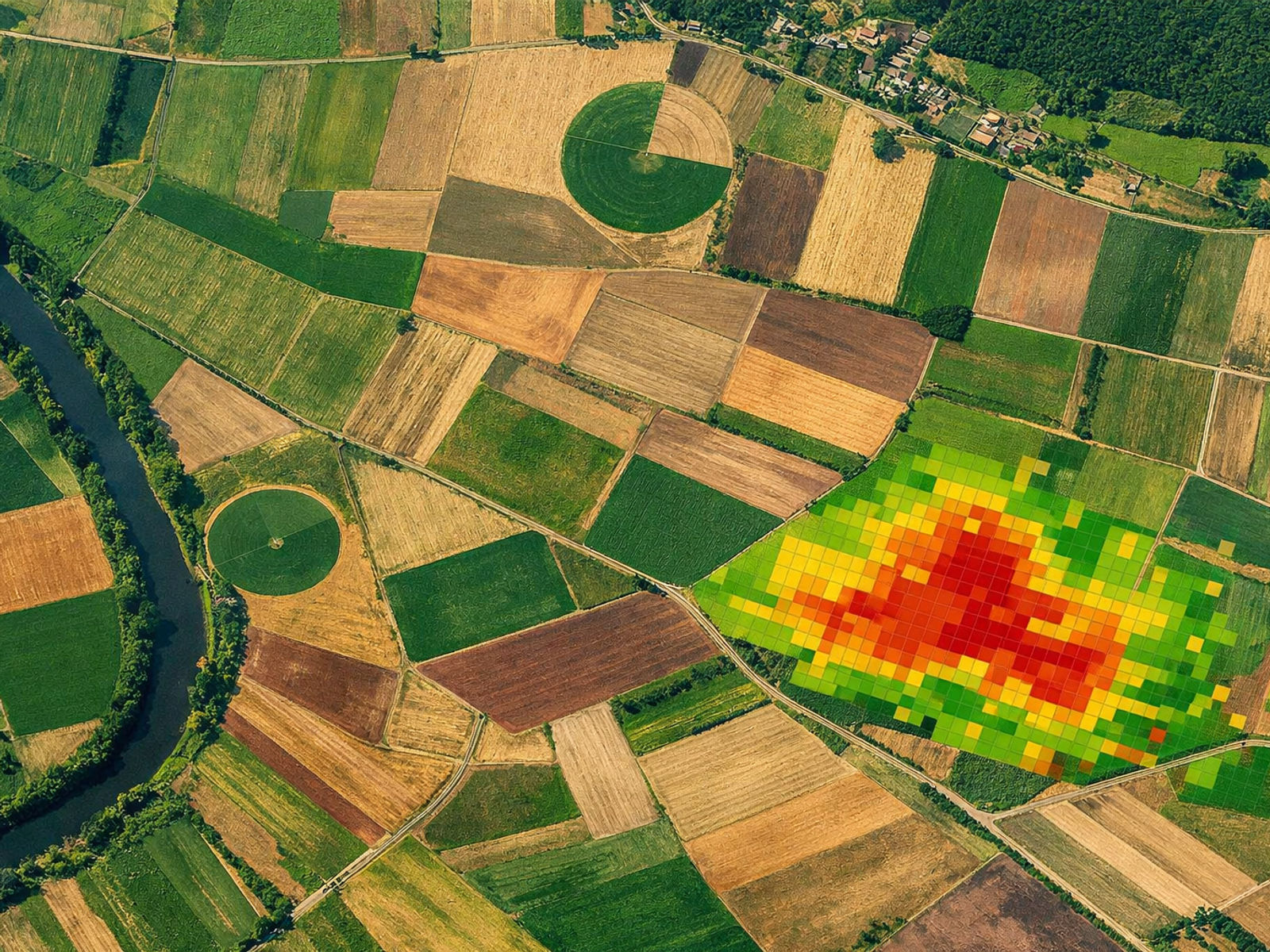
Agricultural and land systems rarely shift all at once. Change usually begins as subtle signals that fail to register in traditional datasets until the window to respond has already closed.
High-cadence satellite observation alters that equation. It allows systems to monitor early crop stress, soil moisture evolution, biomass development tied to yield trajectories, and seasonal anomalies that affect risk and performance. More importantly, it reveals how those signals propagate regionally and globally.
That lead time matters. When models act on emerging signals instead of lagging indicators, prediction becomes actionable, and action becomes advantage.
Digital Twins That Learn, Adapt, and Generate New Data
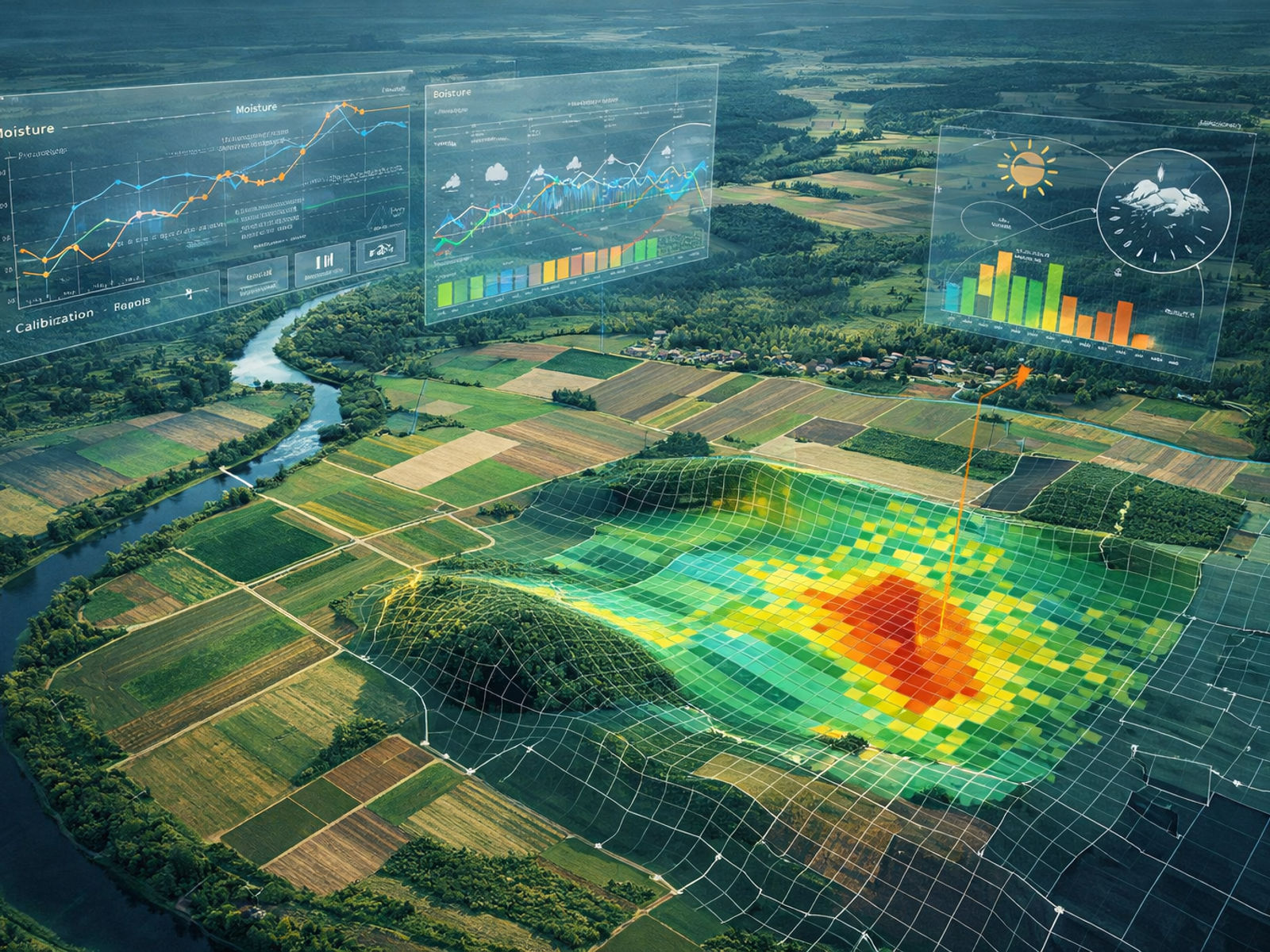
SatYield’s digital twins are not static simulations. They are adaptive systems that ingest real-world signals and recalibrate continuously as conditions evolve.
As new satellite observations arrive, the twins adjust internal parameters, simulate alternative environmental and management scenarios, and generate synthetic datapoints that remain consistent with both physics and observed behavior. This creates a compounding feedback loop: better observation improves simulations, better simulations generate higher-quality synthetic data, and that data steadily sharpens predictive models.
Competitors relying on generic or episodic datasets simply cannot match the learning rate of this type of system.
Why 16 Billion Data Points Per Season Actually Matter
Large language models provide reasoning. They do not provide domain-specific sensory input. SatYield fills that gap by supplying real-world and synthetic data at scale.
Billions of datapoints per season enable:
Robust training of task-specific models
Detection of micro-scale patterns general models miss
Improved uncertainty quantification
Faster error reduction as seasons progress
Two organizations may deploy identical foundation models. The difference is that SatYield feeds those models a proprietary dataset that is continuously expanding. That dataset—not the model—becomes the source of predictive alpha.
Learning Faster: Proprietary Data Advantage in AI

In systems that change continuously, advantage accrues to the teams that learn first and adapt fastest. SatYield improves decision-making by detecting environmental shifts earlier, predicting outcomes with greater spatial and temporal granularity, simulating interventions before commitments are made, and scaling insights across regions and seasons.
This is not about producing text or dashboards. It is about facilitating better decisions sooner, based on data streams others cannot access.
These dynamics are increasingly central to conversations across quantitative research, alternative data, and AI-driven investment, including discussions taking place at Battlefin Discovery Day, where differentiation, signal latency, and learning velocity are core themes.
The Strategic Thesis: Data Will Define the Next Decade of AI
The world is entering a phase where models are universal, but insights are not. Differentiation will come from the quality, exclusivity, and structure of the data pipeline feeding those models.
SatYield’s thesis is direct:
When everyone has the same model, the advantage is knowing something sooner
When everyone builds with similar tools, the edge comes from better inputs
Satellite-driven digital twins create an input layer that compounds over time
That is what long-term alpha looks like in an AI-saturated world.
Meet SatYield at Battlefin Discovery Day, Miami 2026
SatYield will be at Battlefin Discovery Day in Miami in January 2026, engaging with analysts, data teams, and investors exploring how proprietary data systems and adaptive modeling reshape decision-making. If you’d like to discuss applications, integrations, or research collaboration, we look forward to connecting there.
Request a complementary ticket here, and we will see you in Miami!
more from the blog