Market Analysis
In Agriculture, Alpha Is Not Information. It Is Time.
And time is now the most expensive input on a trading desk.
Commodity markets didn’t just change over the past few years. They were completely rewired. Extreme weather is no longer episodic. Supply shocks no longer respect borders.
And government data, once treated as the backbone of market intelligence, now often arrives late, revised, or incomplete precisely when uncertainty peaks.
At the same time, something subtler has happened. Time itself has become scarce, and priced.
In modern commodity markets, advantage is no longer defined by who has access to more information. It is defined by who reaches clarity sooner.
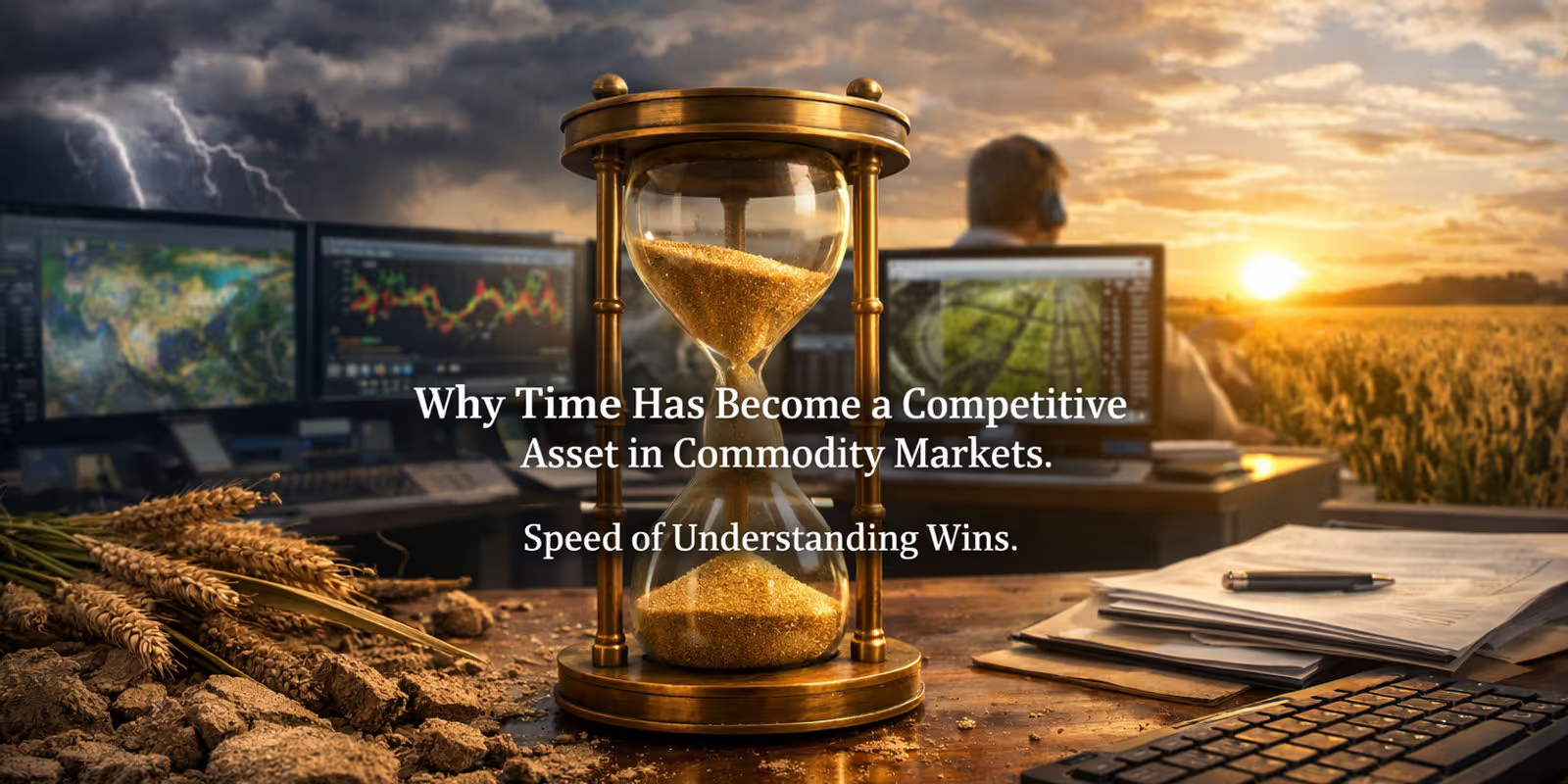
Why Time Has Become a Competitive Asset in Commodity Markets
Volatility has a strange effect on organizations. As uncertainty rises, decision-making slows—not because teams are incapable, but because the cost of being wrong feels higher. More data is gathered. More scenarios are debated. More signals are compared.
What gets lost in the process is momentum.
Economic research has increasingly shown that under uncertainty, people are willing to trade money for time. The logic is simple: when outcomes are unclear, delays carry psychological and economic costs.
Renowned professor and researcher Gal Smitizsky has studied how individuals and organizations value time relative to money, particularly in volatile environments, finding that time becomes more valuable at the margin when cognitive load is high.
This dynamic plays out daily inside hedge funds and trading desks.
The constraint is rarely access to data. The constraint is the time it takes to interpret that data, reconcile contradictions, and reach conviction before the market moves.
The Real Cost of Waiting for Certainty
Most missed opportunities in commodity trading don’t come from ignorance. They come from hesitation.
Teams wait for confirmation that never fully arrives. They delay action while reconciling conflicting forecasts. They postpone decisions until reports are published, only to discover that prices have already adjusted.
The cost is not just lost profit. It is erosion of confidence, elevated stress, and organizational fatigue.
When time is treated as abundant, inefficiency hides in plain sight. When time is scarce, inefficiency becomes risk.
Information as a Bottleneck vs. an Advantage

For decades, the dominant assumption in trading was that better decisions required more information. In stable environments, that assumption held true.
In volatile systems, however, it breaks down.
Today’s commodity teams face an abundance of inputs: weather models, crop reports, satellite imagery, analyst forecasts, and market signals. The challenge is no longer gathering data. It is deciding which signals matter now.
When everything is monitored, nothing feels decisive.
This is where friction accumulates: in meetings, in debates, in dashboards that show activity without clarity. The result is slower decisions, even as markets accelerate.
Speed of Understanding is More Important Than Speed of Execution

In modern commodity markets, alpha increasingly accrues to those who reduce uncertainty earlier, not those who react faster once certainty emerges. By the time consensus forms, opportunity has often passed.
Speed of understanding is different from speed of action. It is the ability to compress the path from raw signals to informed judgment; to know when a change is meaningful, and when it is noise.
That compression is where advantage now lives.
How to Reclaim Time Without Sacrificing Rigor
Treating time as a constrained resource forces a shift in how intelligence systems are designed.
The goal is not more alerts, more charts, or more models. It is fewer moments of doubt and fewer hours spent validating what should already be clear.
This requires systems that continuously integrate data, update beliefs, and surface change as it develops, so teams spend less time reconciling inputs and more time thinking strategically.
SatYield was built with this principle at its core. By transforming satellite imagery, weather, soil, and crop dynamics into high-frequency yield and production signals, the platform shortens the distance between observation and conviction. The value is not the volume of data, but the time returned to decision-makers.
What Will Define Commodity Market Alpha in 2026?

In the weeks and months to come, the edge will not belong to those who process more information.
It will belong to those who reach clarity faster, without burning out teams or waiting for perfect certainty.
The most effective trading organizations will be those that design for learning velocity, reduce cognitive friction, and recognize time as their most constrained input.
Because in markets shaped by volatility, the cost of delay compounds quietly.
And clarity, when it arrives early, compounds even faster.
If time is your most constrained input, your intelligence system should be designed to return it.
Explore how SatYield helps trading teams move from uncertainty to conviction faster, without sacrificing rigor. Take it for a test drive today.
more from the blog