
Market Analysis
USDA Yield Forecasts Are Systemically Wrong. Satellite Intelligence Isn't.
A peer-reviewed study published today by University of Illinois and Ohio State researchers confirms that USDA's crop yield projection methodology is the least accurate of four methods tested — overstating corn yields by 7.2% across an entire decade. SatYield's Versatile Crop Yield Estimator (VerCYE) Digital Twin reads what's actually growing. That's the difference.
What the Research Found
A study published April 15, 2026 in farmdoc daily — authored by Carl Zulauf (Ohio State) and Nick Paulson (University of Illinois) — compared four yield projection methods against actual USDA Risk Management Agency (RMA) county yields across 2015–2024. The analysis covered more than 1,500 U.S. counties and five major crops: corn, soybeans, wheat, cotton, and rice.
The finding is stark: RMA's own methodology ranked last in forecast accuracy for every crop tested.
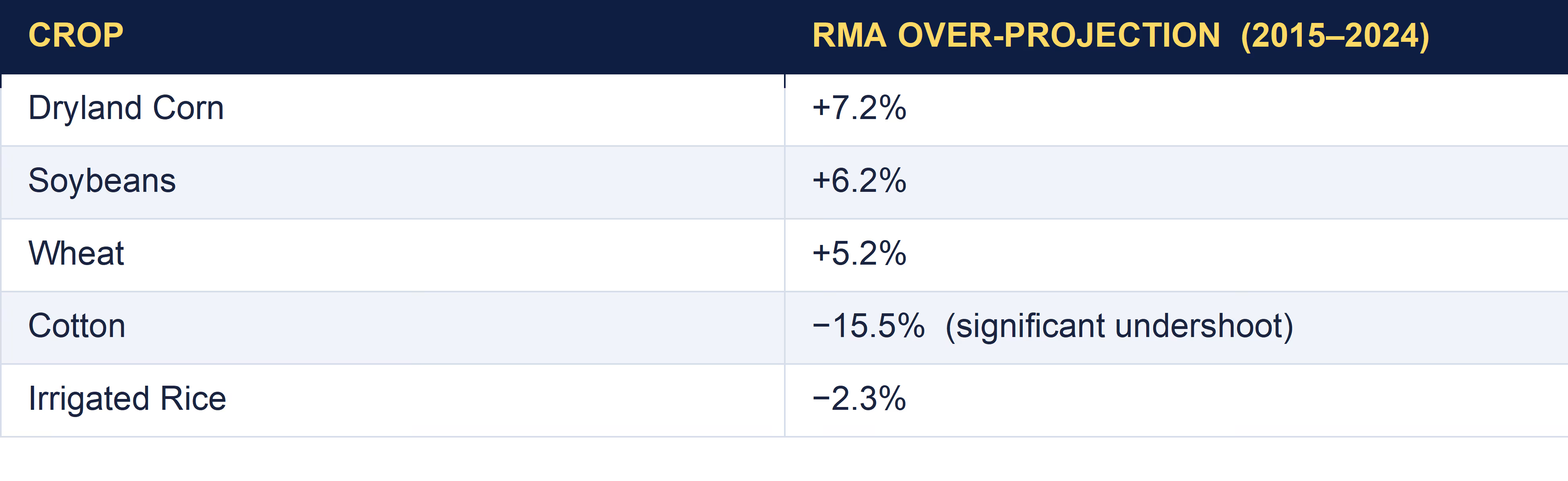
These are not anomalies. They are systematic errors compounding across every supply estimate, every insurance payout calculation, and every WASDE-anchored trade that flows downstream from official yield data.
Key finding: RMA's regression model fit its historical training data (1997–2014) reasonably well. But good historical fit is not forward forecast accuracy. Once yield growth dynamics shifted post-2015, the model kept projecting from a reality that no longer existed.
Why Statistical Yield Models Fail Forward
RMA uses a regression model calibrated to historical county yield data going back to 1991. The logic is intuitive: fit a trend line to decades of data, project it forward.
The problem is structural. Regression models are optimized to minimize error against past observations. They have no mechanism for detecting when the underlying conditions producing those observations have changed. When yield growth rates decelerate — as they did in U.S. corn and soy post-2012 — a trend-fitted regression line keeps climbing on autopilot. This dynamic is explored in depth in our post Weather Alone Is Not Enough: How Satellites and Crop Models Are Reshaping Yield Forecasting.
The farmdoc researchers found that a 5-year moving average excluding the minimum yield — a far simpler method — outperformed RMA's sophisticated regression for corn, soybeans, and wheat. Less statistical machinery, applied honestly to recent data, beat more statistical machinery applied to stale assumptions.
That result alone should reframe how the market thinks about official crop forecasts.
What Satellite Crop Intelligence Sees That Statistics Can't
This is precisely the gap SatYield was built to fill.
From Trend Lines to Live Signal
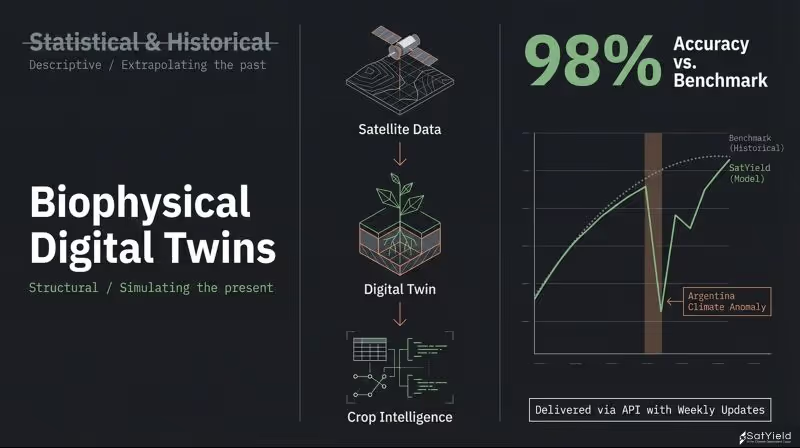
SatYield's VerCYE Digital Twin does not ask: "What has this county historically yielded?" It asks: "What is this crop doing right now?"
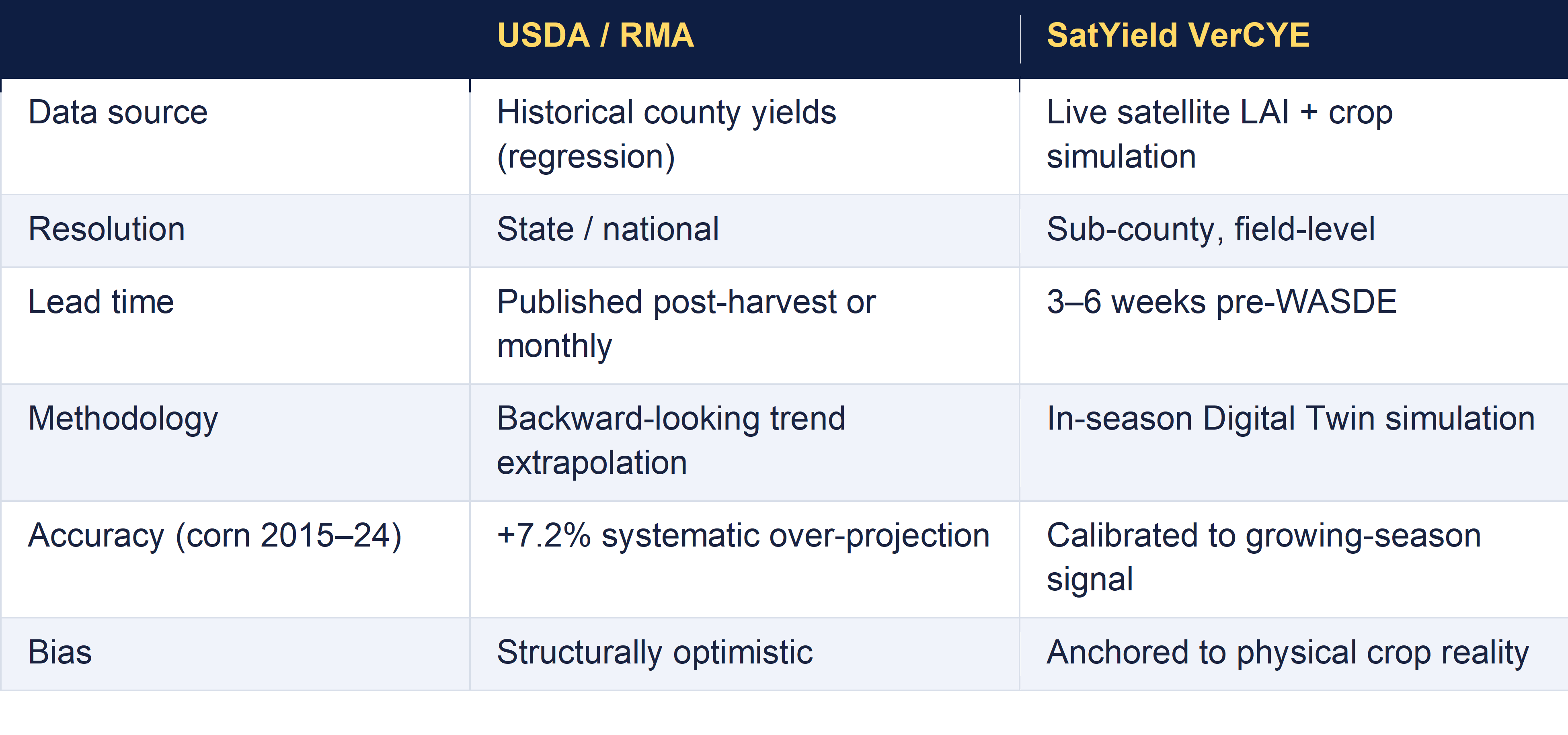
VerCYE ingests satellite-derived Leaf Area Index (LAI) signals at 10-metre resolution, running ensemble crop simulations throughout the growing season. Rather than extrapolating from a historical trend line, the model reads canopy development, stress signatures, and biomass accumulation as they occur — in near real-time, field by field.
The 3–6 Week Lead Time Advantage
When RMA's regression was projecting corn yields 7% above what actually materialized, a satellite-based system anchored to actual growing conditions would have detected the divergence weeks before it appeared in any official report. We documented exactly this dynamic in our analysis of the September 2025 USDA Crop Production Report, where SatYield's models diverged significantly from USDA's projections.
That is SatYield's 3–6 week pre-WASDE signal advantage — not a faster feed of the same data, but an entirely different class of information derived from physical observation of the crop itself. As we argued in The WASDE Is a Newspaper, by the time USDA publishes its monthly estimate, the most important market-moving information has already unfolded in the field.
Sub-County Precision
USDA reports at the state and national level. SatYield's VerCYE produces field-level, sub-county yield estimates — the granularity required for genuine supply intelligence, not supply approximation.
Why This Matters for Commodity Traders and Hedge Funds
The farmdoc study frames its findings in the context of crop insurance fairness. But for institutional participants in agricultural markets, the implications extend much further.
Every major supply estimate the market trades on — WASDE monthly reports, ARC program benchmarks, crop insurance area yields — is downstream of the same statistical infrastructure that this study shows to be systematically biased.
If official yield projections are running 5–7% high for corn and soybeans — for an entire decade — then:
- Supply estimates are distorted before the season begins
- Market positioning anchored to WASDE is trading on a lagged, miscalibrated baseline
- The signal edge belongs to whoever can see what's actually in the field
The edge in agricultural commodities trading is not faster access to the same official numbers. It is access to a fundamentally different signal — one grounded in satellite observation, not statistical extrapolation. As we explore in In Agriculture, Alpha Is Not Information. It Is Time, the decisive advantage in commodity markets now comes from compressing the time between signal and conviction.
SatYield vs. USDA: A Different Kind of Intelligence
The Bottom Line
The farmdoc study is peer-reviewed confirmation of a problem the satellite crop intelligence community has long understood: you cannot forecast a living crop by projecting a statistical trend line.
Crops don't follow trend lines. They respond to rainfall, heat stress, soil conditions, and a hundred other variables that regression models cannot see — but satellites can.
The government's crop math corrects itself one harvest at a time. Always one year too late. Always after the trade has been made.
SatYield delivers the signal before the report. See how our technology works →
Frequently Asked Questions
What is the USDA WASDE report and why does it matter for crop yield forecasting?
The World Agricultural Supply and Demand Estimates (WASDE) report is USDA's monthly benchmark for U.S. and global crop production. It is the primary reference point for commodity markets, agricultural trade, and supply chain planning. Its yield projections rely on survey data and statistical models — the same class of backward-looking methodology the farmdoc study found to be systematically inaccurate. For a deeper breakdown of WASDE's structural limitations, read The WASDE Is a Newspaper.
How does satellite crop yield forecasting differ from USDA estimates?
Satellite-based forecasting like SatYield's VerCYE Digital Twin uses live remote sensing signals — specifically Leaf Area Index (LAI) derived from satellite imagery — to run in-season crop simulations. Rather than projecting from historical averages, it reads the physical state of the crop as it grows.
What is the VerCYE Digital Twin?
VerCYE is SatYield's proprietary crop simulation engine. It integrates satellite-derived LAI signals at 10-metre resolution with ensemble biophysical crop models to generate sub-county yield estimates throughout the growing season. It powers SatYield's 3–6 week pre-WASDE lead time advantage. Learn more about our technology →
What crops does SatYield cover?
SatYield currently covers corn and soybeans across the U.S. and Brazil, with additional crop and geography coverage expanding. See our full crop yield prediction capabilities →
Who uses SatYield's crop intelligence?
SatYield serves institutional clients including hedge funds, commodity trading advisors (CTAs), commodity trading desks, quantitative researchers, and alternative data teams at financial institutions. See all use cases →
What does "3–6 week lead time advantage" mean?
SatYield's satellite-derived yield forecasts are generated and delivered to clients 3–6 weeks before the equivalent USDA WASDE report is published. This window represents a material information advantage for traders positioning ahead of official report releases. Explore why timing is the real alpha →
Related reading: The WASDE Is a Newspaper · Alternative Data: From Noise to Alpha · In Agriculture, Alpha Is Not Information. It Is Time · How Hedge Funds Use Predictive Intelligence · Weather Alone Is Not Enough
more from the blog