
Market Analysis
Agricultural Production Is the Largest Unknown in the Global Food Supply Chain
Every year, trillions of dollars of economic activity depend on one simple question: how much food will the world actually produce? Despite advances in satellite imagery, AI, and crop science, much of the global food industry still leans on periodic government reports and fragmented field observations to answer it.
That gap between the question and the answer is where uncertainty lives. For many organizations, it is not a minor inconvenience. It is one of the largest operational and financial risks they carry, and the companies that consistently outperform are often the ones that reduce that uncertainty earliest.
Why does a single planting decision ripple through the entire supply chain?
A crop is planted once. Every other decision follows it.
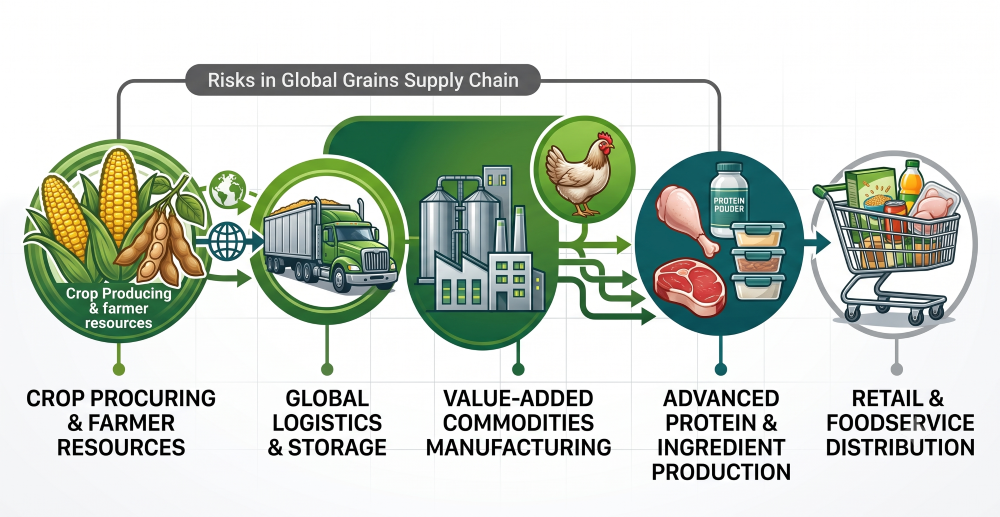
Before grain reaches an elevator, a processor, a port, or a supermarket shelf, thousands of business decisions have already been made based on expectations of future production. Those expectations sit underneath procurement strategy, commodity trading positions, transportation planning, storage utilization, processing capacity, export commitments, working capital requirements, credit exposure, and insurance portfolios.
When production expectations are wrong, every one of those downstream decisions gets harder to make.
What does it actually cost when a production estimate turns out wrong?
Consider a simple scenario. A food manufacturer expects abundant corn supplies heading into harvest and delays purchasing inventory. Weeks later, deteriorating crop conditions reduce expected production. Prices rise. Transportation tightens. Procurement costs increase, and production schedules have to be adjusted.
Nothing about the manufacturing process changed. Only the expectation of future crop supply changed. The same pattern shows up across nearly every agricultural commodity, in nearly every sector that touches one.
Is traditional agricultural reporting still enough on its own?
Government agencies like USDA provide an essential public service, and their reports remain the industry benchmark. But official reports are built to measure agricultural production after the fact, not necessarily to deliver the earliest possible commercial signal. Markets move continuously. Weather changes daily. Crop development changes week to week. Commercial organizations increasingly need information in the gaps between official reporting cycles. We have written before about why traditional agriculture reports aren't enough on their own, and that gap has only grown more consequential since.
In our view, the challenge today is no longer collecting agricultural data. It is turning millions of scattered observations into estimates commercial teams can actually act on.
How has crop intelligence turned into supply chain intelligence?
Modern crop intelligence has grown well beyond estimating final yield. It now answers questions that touch commercial decisions directly: how many acres were actually planted, whether crops are developing normally, which regions are under stress, where production is improving, where risk is building, and how likely current supply expectations are to change. Those answers become upstream signals for everyone downstream of the field.
Who actually benefits from earlier crop intelligence, and how?
High-quality crop intelligence creates value long before harvest, and it shows up differently depending on where an organization sits in the chain.
Food manufacturers
Earlier visibility into acreage, crop development, and regional production gives procurement teams room to adjust purchasing strategy, diversify sourcing regions, improve inventory planning, and reduce exposure to supply shortages nobody saw coming. The earlier a supply risk is identified, the more options remain on the table.
Grain traders
Understanding which producing regions are outperforming or underperforming lets traders monitor localized production risk, sharpen supply and demand assumptions, evaluate basis opportunities, and support more informed risk management. We have found that hedge funds using predictive intelligence and alternative data are already leaning into this earlier-signal advantage. Earlier information simply reduces informational uncertainty.
Logistics providers
Unexpected changes in production ripple into rail demand, truck availability, export terminal utilization, storage capacity, and port logistics. Earlier production estimates give logistics organizations time to anticipate volume changes before harvest actually begins.
Procurement organizations
Earlier crop intelligence lets procurement teams evaluate purchasing timing, adjust supplier diversification, hedge procurement exposure, and improve contract planning. We go deeper on this in enhancing procurement planning and sourcing decisions with yield intelligence. Waiting for confirmation tends to shrink the options available, not expand them.
Banks and agricultural lenders
Earlier estimates of acreage, crop health, and regional yield potential can support portfolio monitoring, credit exposure assessment, regional risk analysis, and loan performance forecasting. This is also where crop intelligence intersects with financing itself, as we explored in how crop digital twins enable ESG-linked agricultural financing. Production risk, left unaddressed, has a way of becoming financial risk.
How did crop intelligence evolve into what it is today?
Historically, estimating crop production relied on surveys, field inspections, and historical averages. Advances in Earth observation, cloud computing, machine learning, and crop simulation have changed what is actually possible. Modern crop intelligence combines multiple independent signals, including satellite observations, crop simulation models, weather data, soil characteristics, historical production, vegetation dynamics, and phenological development. No single data source provides the complete picture. The value comes from combining them into a continuously updated view of how a crop is actually developing.
How does SatYield approach crop intelligence?
At SatYield, we treat crop intelligence as critical infrastructure for agricultural markets. Our platform combines early acreage estimates, in-season yield forecasts, regional production risk assessments, weather and crop stress indicators, weekly crop condition updates, and supply shock probability signals. Using satellite observations together with patent-protected crop simulation digital twins, we continuously evaluate crop development throughout the growing season, an approach grounded in what we call human-plus-machine intelligence rather than either one alone. Rather than waiting for a single reporting date, our objective is to help organizations understand how production expectations evolve week by week, so commercial teams can identify changes earlier and act on them with more confidence.
Is crop intelligence becoming an upstream data layer for enterprise systems?
We do not think the future looks like a series of isolated reports. Instead, crop intelligence is increasingly becoming an upstream data layer feeding enterprise AI platforms, supply chain digital twins, commodity risk systems, procurement software, financial models, banking risk platforms, and trading analytics, the same shift we described in from public data to tradable supply signals. As organizations automate more of their decision making, they need continuously updated estimates of physical agricultural supply feeding those systems. Reliable upstream intelligence becomes a necessary input, not an optional add-on.
So where does this leave agricultural decision-making?
Agriculture will always carry uncertainty. Weather cannot be controlled, and markets will keep reacting to it. But uncertainty can be measured earlier than it used to be, and organizations that reduce it first gain more time to evaluate options, manage risk, and allocate capital well. The future of agricultural decision-making is not just better analytics. It is earlier intelligence, and earlier intelligence starts in the field.
I'm still learning this space. tell me where I'm wrong. DM me.
more from the blog