
Market Analysis
Why the Future of Commodity Intelligence Is Human + Machine, Not Human vs. Machine
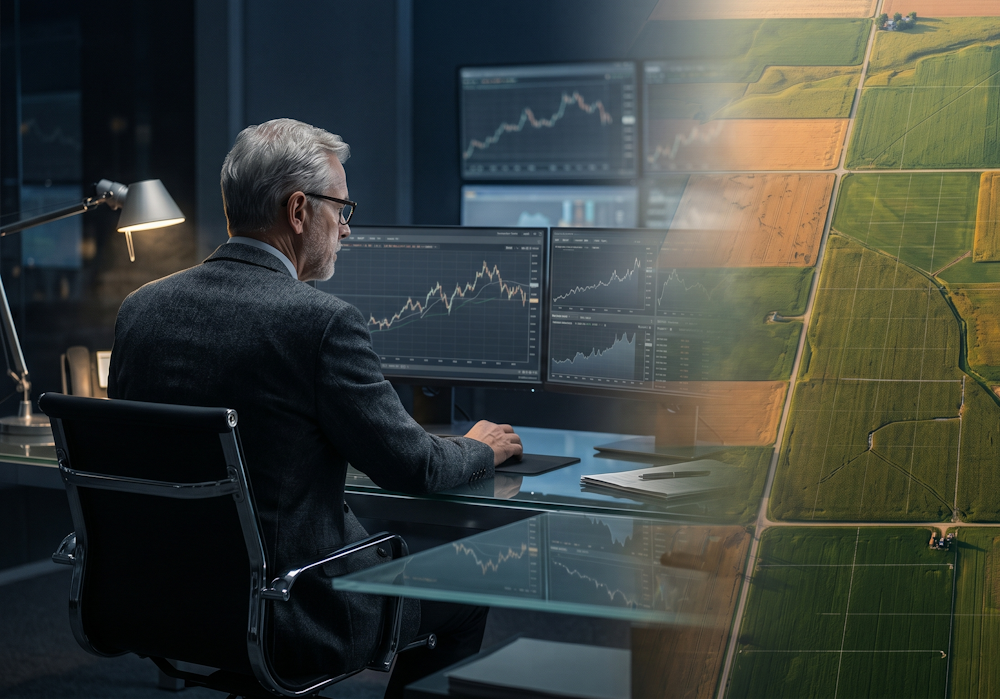
The future of crop intelligence will not be machines replacing humans. It will be humans amplified by machines.
Commodity markets have entered an era of information saturation. Hedge funds, traders, and analysts now wake up to a firehose of satellite imagery, weather feeds, macro indicators, AI-generated research notes, social sentiment, and competing opinions published every hour. The volume of data has exploded. The volume of conviction has not.
In agriculture, this gap is widening fastest. Crops are not digital systems. They are biological systems shaped by physical processes - water balance, radiation, soil structure, phenology, heat stress. And every season, the data describing those systems gets noisier while the questions asked of it grow more consequential.
So the real question for institutional commodity intelligence is no longer how much data can be ingested. It is: who decides what the data means?
Why isn't fully autonomous AI enough for agricultural forecasting?
Modern AI is exceptional at one thing: scaling observation. It can monitor millions of fields, ingest petabytes of imagery, and flag anomalies across entire growing regions in near real-time. That capability is transformative, and purely statistical models built on historical analogs tend to fail precisely when markets need them most - a structural limitation we covered in Why Pure AI Will Struggle in Agricultural Forecasting.
But there is a deeper limitation that gets less attention. Even when AI is technically correct, it is not necessarily useful. A model can surface a thousand anomalies in a single morning. Which ones matter? Which ones move a market? Which ones reflect a structural shift in supply versus a transient artifact? Which ones justify a position?
These are not pattern-recognition questions. They are judgment questions. And judgment is what humans still do better than any model.
What does hybrid intelligence mean in commodity markets?
Hybrid intelligence is a division of labor between humans and machines based on what each does well. Machines scale observation. Humans scale judgment. It is not a compromise between the two. It is a synthesis.
Machines are unmatched at continuous monitoring, pattern detection, scale, consistency, and speed. They never sleep, never miss a satellite pass, and never get tired during the third week of a critical pollination window. They are the substrate on which modern crop intelligence is built.
Humans bring something machines cannot replicate: contextual reasoning, market structure intuition, the ability to weigh competing narratives, and conviction under uncertainty. A senior agronomist can look at a stressed crop and understand not just what is happening, but what it means for a farmer's planting decision next season. A commodity analyst can look at the same supply signal and understand how it will be priced by a market that is already half-positioned for the opposite outcome.
Neither replaces the other. The hybrid is stronger than either alone.
Why does human judgment still matter in an AI-driven market?
Climate volatility is breaking the historical baseline that purely statistical models rely on. Geopolitical realignment is reshaping trade flows. Reporting gaps in government data are widening. And every institutional desk in the market now has access to roughly the same alternative data sources.
When everyone has the same inputs, the edge shifts to interpretation. This argument applies with even more force to human judgment than to data itself, as we explored in When Everyone Uses the Same AI Models, SatYield Creates Alpha from Data Others Don't Have. The analyst who can correctly read a hybrid system - physics-grounded supply signal, machine-scale monitoring, agronomic context - has an asymmetric advantage over the analyst staring at a dashboard of correlations.
This is also why AI in agriculture should be a force multiplier for experts, not a substitute for them. See AI in Agriculture Is Not Replacing Experts. It's Making Them Dangerous.
What are the components of a hybrid intelligence system?
A working hybrid intelligence system combines six interdependent layers:
- Physics-based crop modeling that captures biological reality, not historical correlations
- Satellite observations that ground the model in what is actually happening in the field
- Weather and soil intelligence that constrains the system to physical possibility
- AI and machine learning that scales monitoring, flags anomalies, and ranks signals
- Human agronomic expertise that interprets edge cases and weighs context
- Institutional market judgment that translates supply signals into trading conviction
Each layer is necessary. None is sufficient on its own. Remove the physics, and AI hallucinates during abnormal seasons. Remove the satellites, and the model drifts from reality. Remove the human, and the system produces signals nobody can act on with conviction. We described how the lower layers compress public data into tradable intelligence in From Public Data to Tradable Supply Signals.
How does hybrid intelligence work inside a hedge fund workflow?
For an institutional analyst, the practical benefit of hybrid intelligence is not more data. It is earlier conviction.
A purely AI-driven dashboard tells you what is anomalous. A hybrid system tells you what is anomalous, why it is physically happening, what it implies for in-season yield, and where it sits relative to consensus. The analyst's job moves up the value chain - from chasing signals to forming positions.
We explored this analyst-level shift in The Analyst's Edge: Why Real-Time Crop Yield Forecasting Is the Missing Piece in Ag Commodity Analysis. The strongest desks are no longer competing on raw data access. They are competing on the quality of the interpretive layer sitting on top of it - and that layer is unavoidably human.
Is intuition the opposite of rigor in institutional forecasting?
One reason this synthesis is often missed is that institutional finance has spent two decades treating intuition as a weakness to be automated away. In stable, well-modeled domains, that bias has been roughly correct.
Agriculture is not that domain. Crops respond to conditions that have never been observed in training data. Farmers behave in ways that no historical correlation captures. Regional anomalies cascade through global supply in ways that require structural reasoning, not just statistical inference.
In this environment, the experienced agronomist who has watched twenty seasons of Brazilian safrinha corn is not a relic. They are a calibration source. The veteran trader who remembers what the 2012 U.S. drought actually felt like at the desk is not nostalgic. They are a regime-shift detector. The hybrid system captures their judgment as a layer, not a footnote.
What is the future of commodity intelligence?
The future of forecasting is not AI versus humans. It is intelligence systems where machines scale observation and humans apply judgment, all constrained by physical reality.
That is the architecture we believe will define the next decade of commodity markets. Not autonomous AI. Not discretionary humans. Hybrid systems - grounded in physics, scaled by machines, interpreted by experts, and aligned with how institutional capital actually makes decisions.
The funds that win the next cycle will not be the ones with the most data. They will be the ones with the best synthesis of machine and human.
Explore the SatYield Engine or request live access to see how hybrid crop intelligence integrates with your fund's existing workflow.
more from the blog