
Market Analysis
The Platform Nobody Checks: Why the Best Crop Intelligence Will Disappear
The most indispensable tools in commodity markets are the ones nobody thinks about anymore. The question for crop intelligence isn't who builds the best platform. It's who gets embedded deep enough that no one can remove them.
For years, the conversation around satellite crop intelligence has focused on a single question: is it more accurate than USDA? That was the right question to ask in 2018. It's the wrong question to ask now.
Accuracy matters. But accuracy is table stakes. The more important question — the one that will define which crop intelligence products matter in five years — is structural: where does the intelligence live, and what does it feed?
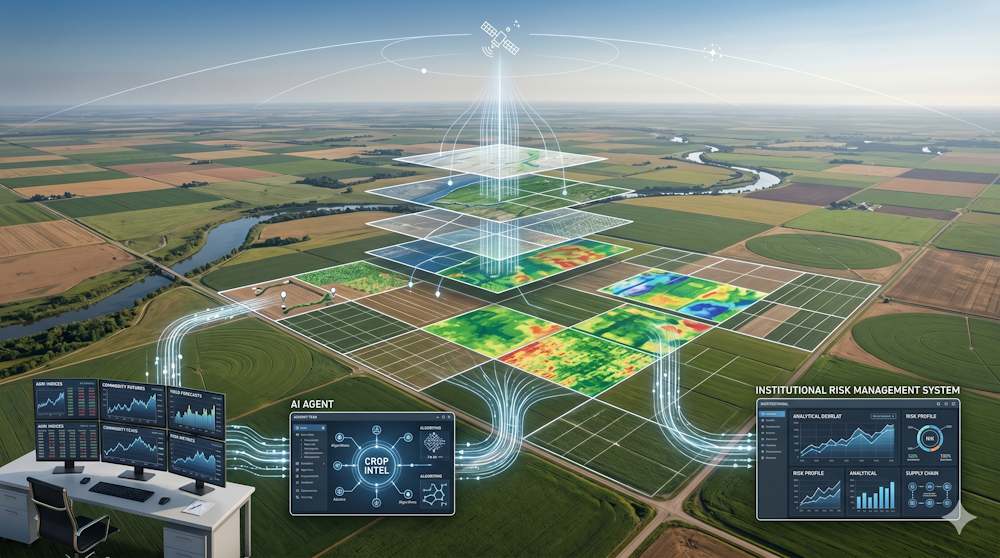
The platforms people consciously log into to check crop conditions are not the endgame. They are a waypoint. The actual endgame is an always-on intelligence layer that runs beneath trading models, AI agents, risk systems, and procurement workflows without requiring anyone to open a dashboard. The best crop intelligence will eventually stop looking like a product. It will look like infrastructure.
What Makes a Tool Indispensable?
Every major category of market intelligence follows the same arc.
It starts as a novelty — something early adopters experiment with and skeptics dismiss. Then it becomes a differentiated edge — the traders who use it outperform the ones who don't, and adoption accelerates. Then something quieter happens: the tool stops being a tool and becomes a default. Users stop deciding whether to consult it. It feeds into their models, their workflows, their downstream systems. They stop thinking about it entirely. It has become infrastructure.
Weather data followed this arc. So did credit ratings, shipping tracking, and satellite imagery for oil storage monitoring. In each case, the transition from "useful product" to "invisible infrastructure" was driven by the same forces: reliable cadence, machine-readable outputs, consistent methodology, and integration into the systems where decisions actually get made.
Crop intelligence is still early in this arc. It's largely in the "consciously check the dashboard" phase. Most users who rely on satellite crop signals still think of it as a product they actively choose to use — a tab they open, a report they download, a platform they log into. The transition to infrastructure hasn't happened yet.
But it's coming. And the organizations that understand what that transition requires will be the ones that define the next decade of commodity intelligence.
Why Agriculture Has Resisted This Transition
Agriculture has had access to satellite imagery for decades. It has not disappeared into workflows the way weather data has. That gap is worth understanding, because it isn't primarily a technology problem.
The first obstacle is coverage reliability. Weather data is continuous. Satellite optical imagery is not — clouds are a fundamental constraint, and in the narrow windows when crop conditions change most rapidly, cloud cover rates in major growing regions can exceed fifty percent for weeks at a time. A signal that goes dark during planting, pollination, or grain fill is not a signal any model can trust as a default input. It becomes something users compensate for rather than build on. As we've explored in Why Pure AI Will Struggle in Agricultural Forecasting, the most fragile moment for a purely data-driven system is exactly when conditions are most dynamic.
The second obstacle is format. Maps and imagery are human-readable, not machine-readable. A trader can look at a false-color NDVI map and form an impression. A model cannot ingest that impression. Infrastructure requires structured, point-in-time, consistently formatted outputs that APIs can query, models can consume, and agents can reason over. Most satellite agriculture products were built for visualization — screens and dashboards — not for the programmatic layer underneath them.
The third obstacle is methodology consistency. Infrastructure carries a different reliability burden than tools. When a tool fails, the user notices and adapts. When infrastructure fails silently, decisions downstream are wrong without anyone knowing why. That means becoming embedded infrastructure requires a level of methodological stability that most satellite ag products haven't been held to: same model, same inputs, same output format, week over week, season over season, year over year — so downstream systems can audit, replay, and validate signals without chasing moving goalposts.
Together, these three obstacles explain why crop intelligence has remained in the "dashboard phase" longer than other alternative data categories. The problem was never whether the imagery existed. It was whether it could be trusted as a background input rather than a foreground tool.
What AI Agents Need That Dashboards Can't Provide
The urgency of this transition has increased significantly with the rise of AI agents in commodity workflows.
AI agents — systems that help analysts synthesize signals, draft market views, flag divergences from consensus, or surface relevant data before a trader thinks to ask — are already operating in commodity markets. The question of what they need to function well is no longer theoretical. And what they need, crop intelligence currently cannot reliably provide.
An AI agent can reason. It can weigh probabilities, synthesize narratives, compare current readings to historical distributions, and flag anomalies. What it cannot do is perceive. It cannot see the Mato Grosso canopy stress index. It cannot know that the Safrinha corn area in Goiás diverged from the government estimate by three percent six weeks before the official report. It cannot feel what a late-June heat event means for soybean pod set in Iowa unless something has already translated physical reality into structured, queryable form.
That translation layer is precisely what crop intelligence must become. As we've argued in The Feature Gap: Why Quant Funds Are Losing the Ag Signal War, the bottleneck for quantitative agricultural strategies isn't compute or modeling sophistication — it's the absence of reliable, structured crop signals that systematic strategies can consume with confidence. The same bottleneck applies to AI agents. They are blind to ground truth from space unless someone builds the bridge between satellite observation and machine-readable intelligence.
Dashboards are not that bridge. An API that returns a reliable, point-in-time yield estimate for corn in Mato Grosso — consistent in format, traceable in methodology, available every week regardless of cloud cover — is.
From Platform to Layer
What does embedded crop intelligence actually look like in practice? It's worth being concrete, because the abstract version is easy to dismiss as vision-deck language.
A quantitative fund's Brazil exposure model currently requires an analyst to pull the latest CONAB estimate, note the date, check whether SatYield's signal diverges, and manually update an assumption. In the embedded version, the model queries a crop intelligence API every Monday morning. If the satellite-derived area estimate has moved by more than one standard deviation from the government figure — as it did eight weeks before CONAB's May 2026 report — the model flags it automatically. No analyst involvement required until a decision threshold is crossed.
A grain procurement team currently runs their sourcing models on USDA and CONAB projections, supplemented by occasional third-party crop tours. In the embedded version, the procurement planning tool surfaces a yield-below-consensus signal during grain fill, before the WASDE, and the team adjusts forward contract exposure while the basis is still favorable. As we've detailed in Enhancing Procurement Planning with Yield Intelligence, the value isn't the signal itself — it's the signal arriving in the system where the decision gets made, at the moment it can still change outcomes.
A Bloomberg terminal user working through an AI assistant asks: "What's the current consensus view on U.S. corn yield versus satellite-derived estimates?" In the embedded version, the AI assistant already has access to a structured crop intelligence feed. It doesn't search. It retrieves. The answer includes the current SatYield estimate, the USDA midpoint, and the historical accuracy of each over the last five seasons.
None of these scenarios require a user to log into a platform. That's the point.
The Trust Standard for Background Infrastructure
There is a reason not every crop intelligence product can make this transition, and it isn't primarily about technology capability. It's about the standard of reliability that infrastructure demands.
When a tool is in the foreground, errors are visible. A user sees an anomalous reading and questions it. They cross-reference. They exercise judgment. The tool is one input among several, and the human is in the loop.
When intelligence runs in the background, that human check disappears. A model consuming a weekly crop yield signal doesn't stop to question whether the methodology changed. A procurement algorithm doesn't flag that the classification approach was revised mid-season. Silent errors in background infrastructure propagate downstream before anyone notices. The stakes of getting it wrong are categorically higher.
This means the trust standard for crop intelligence infrastructure is not "better than USDA on average." It is: consistent methodology across seasons and geographies, independent classification that doesn't inherit the limitations of the surveys it's meant to supplement, point-in-time reproducibility so downstream systems can audit historical signals, and weekly cadence that matches the pace of actual crop development rather than the reporting cycle of government agencies. The timing argument isn't just about being early — it's about being early consistently enough that downstream systems can depend on the cadence.
These are not product features. They are infrastructure requirements. And meeting them is harder than building a compelling dashboard.
SatYield's View
SatYield is building toward this infrastructure standard deliberately. The physics-based crop model — built on satellite imagery, weather inputs, and soil data rather than statistical curve-fitting — is designed to maintain signal quality during exactly the conditions when statistical models fail: novel weather patterns, regional anomalies, the early-season windows when historical correlations break down. The independent global crop classification layer provides area estimates that aren't anchored to the surveys being revised. And the weekly point-in-time output format is structured for programmatic consumption, not just human review.
The Bloomberg integration isn't a distribution strategy. It's the beginning of the infrastructure thesis in practice — crop intelligence delivered inside the environment where institutional commodity decisions already happen, without requiring a separate platform visit.
The goal is not to be the best dashboard in ag intelligence. The goal is to be the signal layer that nobody has to think about, because it's already inside every model, every agent, and every workflow that needs to know what's actually happening in the field.
The future of satellite agriculture will not be defined by who has the most images. It will be defined by who earns enough trust to disappear.
more from the blog