
Overview
Agricultural lenders provide billions of dollars of credit against farms, crops, inventories, and expected agricultural production.
Yet once capital is deployed, visibility into the physical crop underlying that exposure can be limited.
Lenders traditionally rely on borrower reporting, historical production, financial statements, crop insurance, commodity prices, and periodic field or collateral inspections.
These remain important inputs. But they do not continuously answer a fundamental question:
What is actually happening to the crop supporting the loan right now?
Satellite-driven crop intelligence creates an independent observation layer between underwriting and repayment, allowing lenders to monitor crop development and expected production throughout the season.
The Challenge
Agricultural lenders face four structural limitations:
- Dependence on Reported Information
Much of the information about planted acreage, crop development, and expected production originates from the borrower or periodic third-party assessments. - Limited Visibility Between Underwriting and Repayment
A loan may be underwritten months before harvest. During that period, crop conditions and expected production can change materially. - Difficult-to-Scale Collateral Monitoring
Physical inspections provide valuable information but become expensive and operationally difficult across thousands of borrowers and millions of acres. - Late Identification of Production Risk
By the time deteriorating crop conditions become visible through borrower financial performance or repayment concerns, the underlying production problem may have been developing for weeks or months.
Result: Lenders can have significant financial exposure to agricultural production without continuously observing the physical asset supporting that exposure.
The Solution
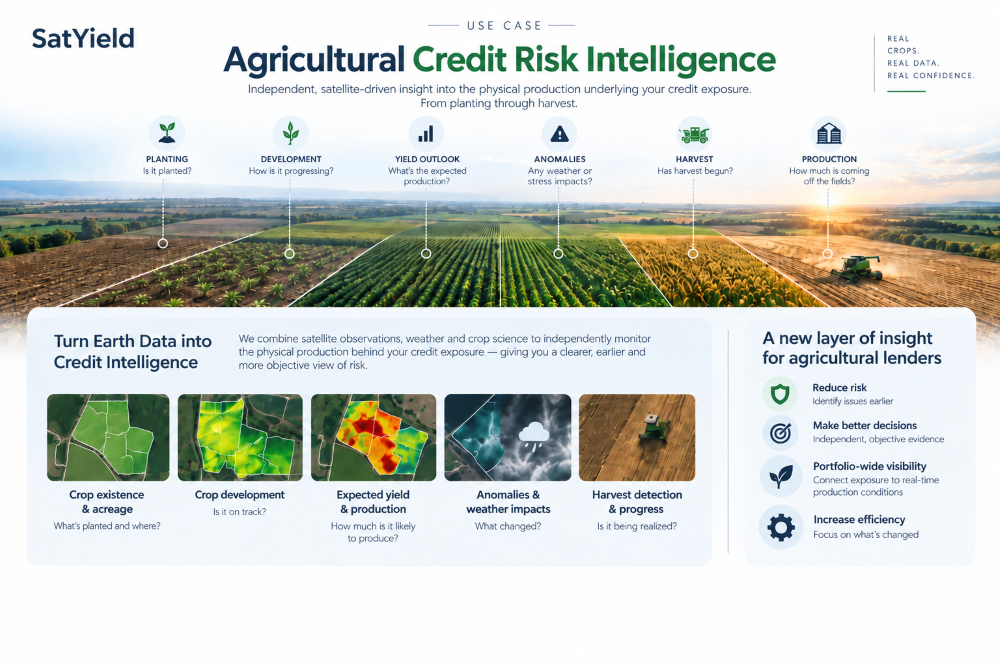
SatYield creates an independent agricultural intelligence layer between the lender and the physical crop.
Using satellite observations, weather, soil information, and biophysical crop models, SatYield continuously monitors crop development and expected production from planting through harvest.
1. Crop and Acreage Verification
- Detect whether crops are present across financed acreage
- Identify crop type and planted area
- Compare observed acreage with expected or reported production areas
- Establish an independent baseline for ongoing monitoring
2. Continuous Crop Development Monitoring
- Track crop development throughout the growing season
- Monitor phenology, vegetation development, biomass, and environmental conditions
- Compare current development with expected seasonal trajectories
- Detect meaningful deviations across fields or geographic regions
3. Forward-Looking Yield and Production Intelligence
- Generate updated yield estimates as crops develop
- Combine expected yield and acreage into production estimates
- Track changes in expected production throughout the season
- Provide visibility into potential production well before harvest
4. Early Risk Detection
- Identify fields or regions showing abnormal development
- Detect emerging production deterioration before financial performance reflects it
- Surface weather and crop-related risk concentrations
- Prioritize exposures requiring additional review or borrower engagement
5. Portfolio-Level Credit Intelligence
- Aggregate crop intelligence across borrowers, geographies, crops, and loan portfolios
- Monitor expected production associated with agricultural exposure
- Identify geographic concentrations of production risk
- Integrate structured crop intelligence into existing credit and risk systems
Outcomes & ROI
- Earlier Identification of Credit Risk
Detect deterioration in the physical production underlying a loan before it becomes visible through traditional financial indicators. - Independent Collateral Intelligence
Add an objective observation layer alongside borrower-reported and financial information. - More Efficient Portfolio Monitoring
Continuously monitor large agricultural portfolios without proportionally increasing field inspection resources. - Better-Informed Credit Decisions
Bring current crop conditions and expected production into ongoing credit review and risk management. - Proactive Borrower Engagement
Identify potential production problems earlier, allowing lenders to engage borrowers before those issues become repayment problems. - Stronger Portfolio Risk Management
Understand exposure not only by borrower and loan value, but also by crop, geography, development stage, expected yield, and expected production.
Summary / Conclusion
Agricultural lending does not need another credit score.
It needs better visibility into the physical production supporting agricultural credit.
SatYield provides an independent intelligence layer that continuously observes crop development and expected production from planting through harvest.
For agricultural lenders, this means:
- From borrower reporting → to independent crop observation
- From periodic inspections → to continuous monitoring
- From historical production → to forward-looking yield intelligence
- From reacting to repayment risk → to identifying production risk earlier
The result: a new physical intelligence layer for agricultural credit risk.