
Overview
This study examines the 2024/25 Soybean season in Brazil, focusing on the spatial divergence between Northern and Southern production hubs. While national averages suggested stability, SatYield's sub-pixel analysis identified early-stage moisture stress and biomass depletion in key regions before traditional field reports could react.
- Context
- Institutional Commodity Trading involving hedge funds and trade houses relying on traditional reporting cycles.
- Asset Class
- CBOT Soybean Futures & Regional Cash Benchmarks
Challenges
The Information Gap
Market reliance on monthly USDA/CONAB reports created a 3-week blind spot during the critical January pod-fill stage. Traditional reporting lags behind the physiological reality of the crop.
- 21d
- Reporting Latency
- 4,200
- Observation Points
- High
- Market Uncertainty
Solutions
SatYield deployed weekly multi-spectral analysis across 10m resolution land cover, effectively decoupling national averages into granular regional components.
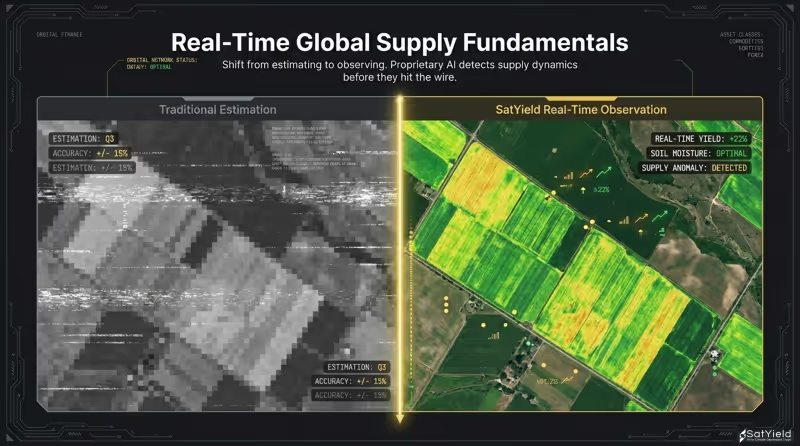
- Sub-pixel Crop State Analysis
Measuring biomass density and senescence signals daily to detect moisture stress 4-6 weeks before consensus. - 15-Year Baseline Comparison
Contextualizing current signals against historical growing seasons to eliminate seasonal noise.
ROI & Outcomes
Operational Edge
- Identify supply-chain risk 20+ days before public reports.
- Increase conviction in spread trading between regional benchmarks.
- Verify boots-on-the-ground anecdotal reports with objective data.
- Predictive Lead Time
- 23d
- Before Market Equilibrium
Conclusion
By decoupling national production averages into granular regional components, traders capitalized on the local supply shock weeks before the broad market adjusted. The ability to observe crop dynamics at high frequency across vast geographies transforms agricultural intelligence from a reactive report to a predictive engine.
"Earlier signals, better timing. Alpha comes from seeing change first."